Nature’s way

Published on Wednesday July 27th, 2011

SpringVines (1 of 3)

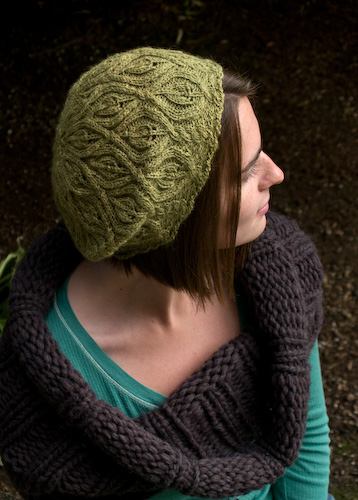
I knit this beret back in April. April is a pretty sensible month to wear some kind of hat in Oregon, because it can still be pretty wet and cool. (Actually, it turns out July can also be wet and cool, at least this year.) The yarn was a perfect spring green, and the design (Autumn Vines) of leaves and twisting vines was so evocative of new growth. But it turns out I need to wait until we’re really back in the depths of midwinter gloom to wear this hat. The yarn is colored with natural dyestuffs — plant matter — and it is even less lightfast than I would have suspected. I blocked the hat over a plate, and I thought I’d set that plate outside on the laundry rack for the afternoon so it would dry more quickly. I always avoid laying any of the woolens out in bright sunshine, especially if I think their colors might be vulnerable to fading, but this was an overcast day.
SpringVines (2 of 3)

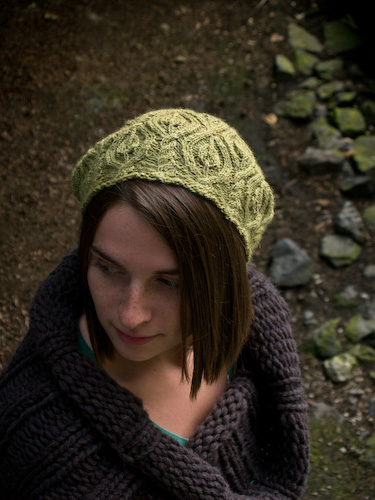
Not overcast enough, though. After just a few hours, the top of the hat was distinctly yellowed, while the brim that was turned beneath the plate retained the original green. It’s even more noticeable in person than in these photos, and not exactly a look I was after! With wear, the whole hat should “weather” to yellow, and I’ll admit I’m curious to see what its final shade will be. Yellow is not really a great color for me, unfortunately. I can always overdye it, so I’m not counting this a failure — it’s still a nice little hat, and the yarn (a 65% wool/35% silk 2-ply from Rainshadow Yarns in Kingston, WA) was a pleasure to work with. It has a faintly crunchy woolen-spun hand with a bit of luster from the silk and the longwool fibers. And I don’t mean to criticize dyer Marcia Adams; plant-dyed fibers are processed close to the earth and it’s only natural that they should be less resistant to sunlight or hot water than fibers treated with stronger synthetic chemicals. I do mean to caution knitters to treat these special yarns with extra tenderness and to accept that change and weathering are to be expected. That’s nature’s way.
SpringVines (3 of 3)

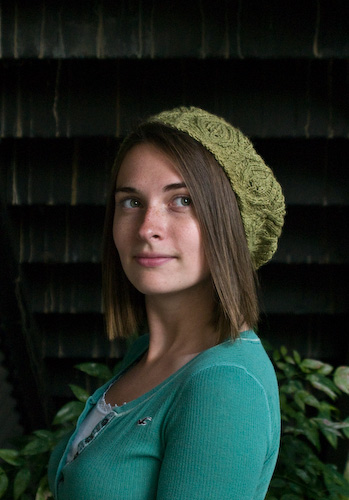
Thanks to Lorelei for being a patient and photogenic model!

These pictures are from a little workshop I took with my friend Vivian to start making better use of my DSLR, an Olympus E-500. It’s amazing how a few simple pointers from a pro can make a difference. Begone, busy backgrounds that distract from the simple story of the portrait! I shall place my subjects farther from textured walls. I shall boost my ISO in low light. I shall think in terms of the triangle created by the photographer, the subject, and the light source. I think I shall even start saving for a 50-mm lens.

(Vivian did not, alas, impart any nifty tricks for those times when you wish to photograph small, fast-moving subjects who want only to climb the photographer and get their sticky little paws all over the camera. Plays hell with the aforementioned triangulation and depth of field, not to mention the focus. But this, of course, is also nature’s way.)
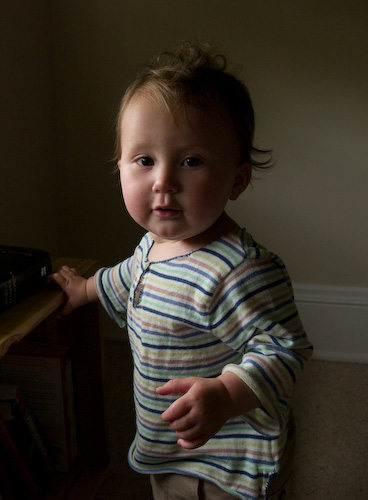

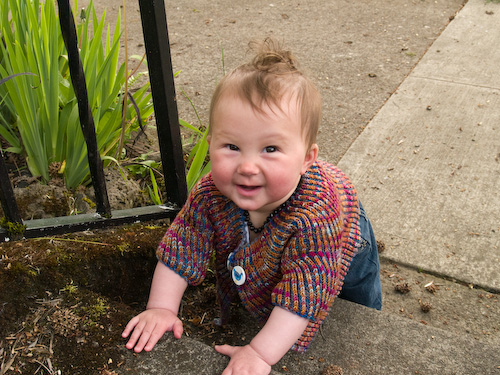
Ada, 12 months (1 of 2)

Ada, 12 months (2 of 2)

I have yet another photography class planned for Sock Summit, this time with Franklin Habit. Because it’s tough to take interesting and effective pictures of socks, and I do have a new one I’m hoping to share with you soon! By next week, I may even have two: I’m spending Friday with Cat Bordhi (whom I have never met, despite hailing from the same small town) in “Personal Footprints for Really Rebellious Sock Knitters.” I don’t know that I qualify as a really rebellious sock knitter. The word rebel comes to us from Latin rebellis and originally connoted a fresh declaration of war by the defeated party. In truth, I’m happy to knit socks in the traditional top-down ways, with their multitude of heels and toes developed in different cultures and time periods, each handsome and useful in one situation or another. But I heartily admire Cat’s toe-up architectures and have found them both beautiful and comfortable as well as mind expanding. In short, the more possibilities, the better. I go to embrace rather than to make war. And I go in happy anticipation of rubbing elbows with sock-loving fools from around the world: welcome to Portland, my people! (And how did I miss our mayor’s proclamation that this week shall be Sock Knitting Week? I am always going to wish I could step out my back door and be in the woods and fields, but I love my adopted city.)
For jauntiness, on or off a bicycle

Published on Sunday July 3rd, 2011

If you’ve read this blog for any length of time, you know what July means: the Tour de France and its celebratory knit-along! I already know I’m going to fail at completing this year’s epic project (on which more later), so I thought I’d at least kick things off with a little bonbon… after all, it’s been a while since there was a new free pattern up here, ne c’est pas?

Vilaine (1 of 4)

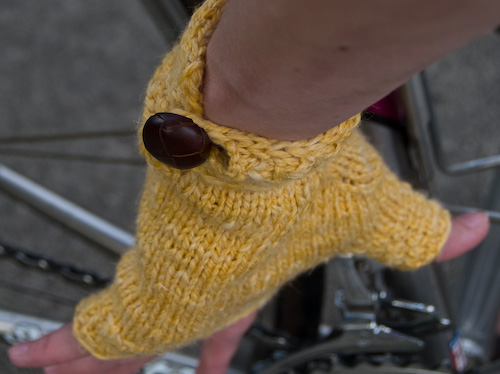
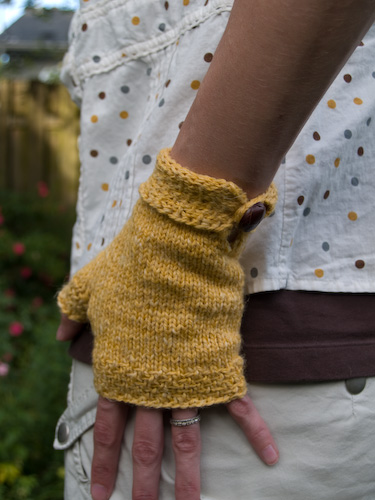
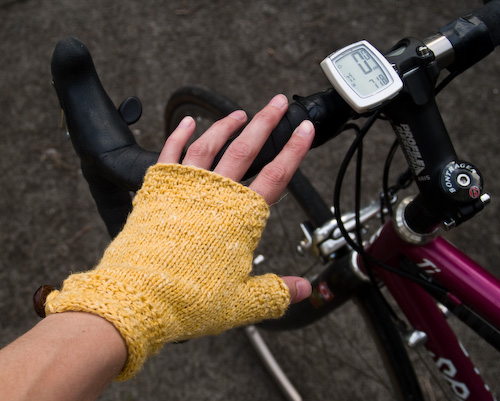
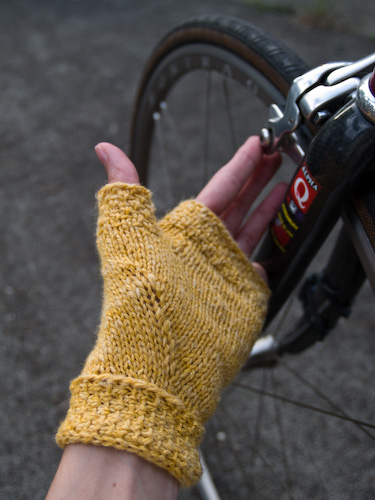
How about a simple pair of fingerless gloves inspired by cycling wear, with just a few classy details? I’m calling these the Vilaine Gloves in honor of the river the peloton will cross on their way into the finish town of Redon tomorrow. I knit them using far less than one skein of The Fibre Company’s Savannah DK, a summery blend of wool, cotton, linen and soy, but the pattern is written with length and percentage measurements so that you can use a yarn of any weight from your stash.

If you’d like to have at it, the pattern is here: VilaineGloves

More pictures? Glad to oblige.

Vilaine (2 of 4)

I used one of my favorite thumb gussets, placing the increases only on the palm side. This treatment is most useful if there’s patterning on the back of the hand you don’t want to disturb, but I like the way it looks in general.

Vilaine (3 of 4)

Final point of polish: a professorial leather button to close the wrist band. One needn’t, of course, wear these gloves for actual cycling, so you can choose as dressy a button as you wish.

Vilaine (4 of 4)

As always, please contact me right away if you find errors or tricky bits in this pattern. Full disclosure: I knit and wrote this sucker in the space of two days. During the first, the yahoos up the hill who can’t wait until 4 July to light their illegal fireworks panicked my poor dog, who jumped or squeezed under the fence and went on the lam for a night and a day, causing anxiety and heartbreak in all quarters. (Thanks to all that is good in the universe, she was not run over on Sandy Boulevard and kind souls Jean and Tim coaxed her into their home and reported her so I could retrieve her the next afternoon. She is terribly footsore but safely home.) Then last night the baby decided to conduct a one-girl circus in our bed for several hours. All this is by way of saying there are probably errors, so knit with sense and trust your judgment, mes amis.

Dual beauty

Published on Friday June 17th, 2011

hoppybirdday (1 of 2)

from a little series we took as a birthday gift to my mother

If I were a photographer, I would do a whole study of children with books. During my senior year, my college hosted a show of Abelardo Morell’s photographs of books. I was ensorcelled. I’ve appreciated books all my life, first as vessels of story, later also as objects with their own beauty, but under Morell’s lens they become landscapes, new worlds taking physical as well as figurative form. (Appropriately, he illustrated Alice in Wonderland in 1998.)

I’ve been thinking about the beauty of the form magnifying the beauty of the content since I visited the Lloyd Reynolds retrospective exhibit at Reed College last week. (Alas, it has closed, so you can’t go see it now.) I had the chance to go with our fourth and fifth graders, who have been studying the arc of human achievement across the millennia, from the ancient constructions through the Renaissance, and have learned both calligraphy and typesetting. Lloyd Reynolds was internationally known as a great calligrapher and teacher of calligraphy; he also designed books and carved woodblocks and Punch and Judy puppets. He influenced pretty much everyone practicing calligraphy in the Northwest today and can even be credited with the existence of decent type faces for the computer, thanks to his sway over students like Steve Jobs (who dropped in on Lloyd’s classes after he dropped out of Reed) and Sumner Stone. The kids and their teachers and I admired scores of his hand-lettered signs, weathergrams, favorite verses and quotations, and diagrams of pleasing page formats and relationships between letters. Later we got to try our own hands at some calligraphy, and I was struck by Lloyd’s advice to his students:

LloydReynolds2The Order of the Black Chrysanthemum was his tongue-in-cheek name for the brotherhood of calligraphers, who could always be identified by the generous ink blots on their shirts, should they absent-mindedly place their pens in their breast pockets. And he wanted aspiring calligraphers always to use large pens so that their mistakes would be loud, proud, and easy to spy. Then they could do better the next time. I love this. It’s entirely counter to my own penchant for fastidious workmanship, but too often those efforts wind up crabbed and I never get the flow. My pen was not nearly large enough for my mistakes on this day, as you can see from my unlovely samples here, but I thoroughly enjoyed myself and have been seized by a desire to take a calligraphy class and to read the work of Edward Johnston, which Lloyd wrote was “a lightning bolt” for him when he studied design. I also wish there were a biography of Lloyd himself. One case in the gallery was devoted to ephemera from his investigation by the House Un-American Activities Committee; he refused the summons to testify and I found his words on the subject deeply satisfying: “I’m no hero, but I hate to get down on my knees unless I’m planting onions or looking for collar buttons.” They put me in mind of E.B. White.

After we’d done some practice sheets (the kids wrote out the Shakespeare quotations they’d memorized), each of us penned a weathergram — a poem of only about ten words written on a strip of paper from a grocery bag and hung outdoors to weather — and found a home for it on Reed’s grounds. There was lunch and a merry game of Capture the Flag, girls against boys. I only played defense because, although I am old and out of shape in comparison to your average healthy ten-year-old, I have much longer legs. But I made those boys think twice about an assault on our pile of cones. It was bliss.

LloydReynolds 1

Even better was the chance afterward to peek into the Special Collections library, a treasure trove of ancient books — Ptolemy, Pliny, antiphonaries, bestiaries, Isaac Newton — and beautiful art books of more recent vintage. The children had to hold the elevator for the adults who couldn’t tear themselves away at the end.

I returned to my usual job, which currently consists of wresting an algebra book out of InDesign —a program I am totally unqualified to use — and wished I could be spending this much time hand-lettering the darn thing or setting it in metal type. It feels ironic that, at a school so heartily devoted to making things by hand, I’ve got the job of translating it all for the outside world via computer. (Nobody senses this irony better than my husband, who knows just how limited my competence with computers actually is.)

I find myself longing for Ada to be a few years older so that she and I can make things together. I don’t want to rush these sweet baby days of wonder and discovery, but I picture setting up a scriptorium in the living room bay and the two of us crafting hand-lettered books. Right now my future calligrapher is screaming about the indignity of nap time and gnashing her stuffed otter with her gums in frustration, so we have a little way to go. I’d better go read her a book. One step at a time.

Oh, and my favorite thing from the Reynolds exhibit, a tiny woodblock print only an inch and a half wide:

Reynolds_boat (1 of 1)

Summer swing

Published on Thursday June 2nd, 2011

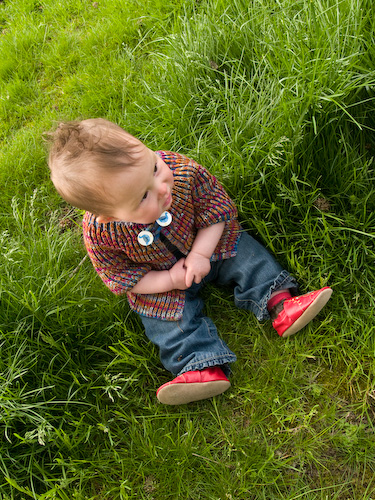
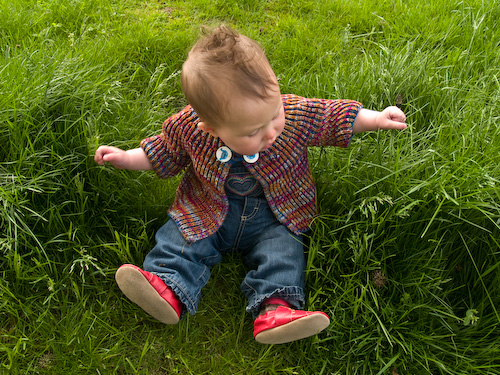
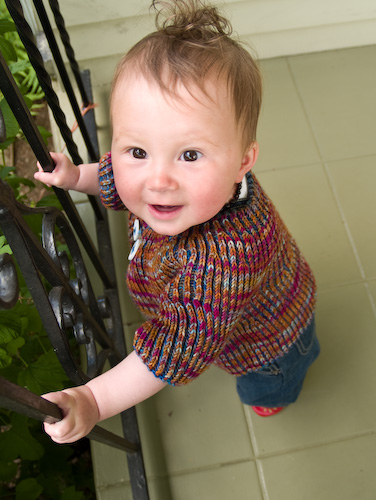
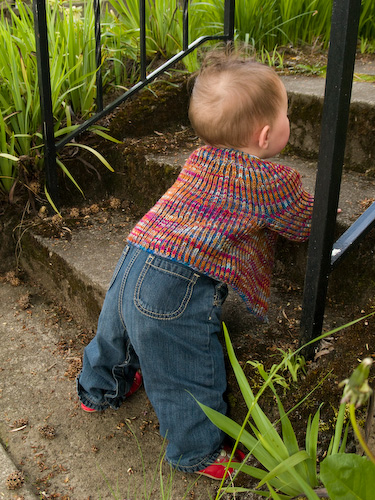
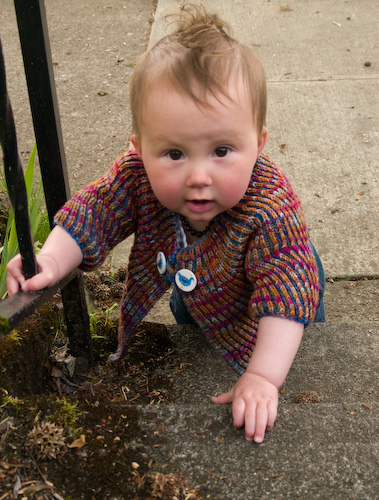
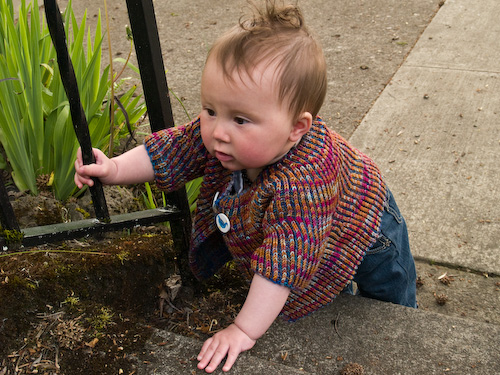
Just before Ada was born — and only just: checking my notes, I see that our labor began four days later — I finished what I think is going to be the signature piece in her wardrobe for the next two seasons. My friend Jen had dreamed up an adorable new baby sweater (she knit a lovely lavender-and-yellow sample that Ada has been wearing all winter) called Baby Brioche; in a fit of third-trimester ambition, fired up by the brioche possibilities explored by Nancy Marchant, I adapted the pattern to use two colors. This month, it fits my girl.

Ada, 10 months (7 of 9)

Ada, 10 months (8 of 9)

(Mr. G saw this photo and said, “Is that our lawn?” He mowed it promptly thereafter. Thanks, love!)

Ada, 10 months (2 of 9)

10 months old and still no teeth!

A word about the hair before we get back to the cardigan: yes, it actually grows that way. But I like to tell people we get up at 5:30 in order to spend an hour fixing it just so with the curlers and blow dryer. I suspect we’ll be making appeals to all our curly friends for hair management advice, because Mama sure hasn’t had to deal with anything like this on her own head! I mean, do you even try to brush it? My friend Maria recommends a spray bottle of diluted leave-in conditioner, which sounds pretty reasonable for a squiggly toddler… But for now, back to the sweater.

Ada, 10 months (3 of 9)

Yarn: Socks That Rock Lightweight (NB: Jen’s single-color version is written for Heavyweight) in Blue Brick Wall (furrows) and a Rare Gem (ribs) that’s similar to Bumbleberry and Flower Power. It’s completely reversible; I sewed buttons on both sides. So far, I’m thinking this was worth the extra effort. I love the color combination no matter which side is out, and it’s so practical to be able to turn it around if one side gets foody or spitty when we’re on the go.

Needles: 2.75mm, US #2. Brioche is so loose and fluffy that you need to use a smaller needle than you’d think.

Modifications: I learned everything a person needs to know about basic brioche and two-color brioche from Nancy Marchant’s website and book, both of which should be considered knitterly world treasures. Don’t be intimidated by the new notation you’re going to encounter within; because brioche requires combinations of familiar movements (yarnovers plus knitting or purling and slipped stitches), it makes sense to offer a new shorthand, and that’s what Nancy has done. Jen has used Nancy’s system, and I think you’ll find it’s straightforward and sensible once you spend a little time with it. I will make my notes with the specific numbers necessary to recreate Ada’s jacket available this summer (or, um, as soon as I find them in my shameful mess of a woolery), but if you’re itching to start now, all you really need is Jen’s pattern and Nancy’s website. I cast on about 30% more stitches because I was using the lighter wool, and after stabilizing the cast-on edge I’m happy with the result, but the Channel Islands cast on and the brioche pattern are so stretchy that you could, instead, start with the numbers in the pattern and then add an extra increase round in the yoke before you divide for the sleeves. This would give you a sweater with a snugger neckline than Ada’s jacket has. Also, I added a round of increases halfway down the body to achieve a swingy line. I thought this would be extra cute on a little toddler and would work well with the single closure point I was planning, and I stand by that decision now that I see it on my babe. Especially since she came with lady tackle. I made no pretense of any intuition about her sex while I was pregnant, but apparently my fingers knew something my brain didn’t. Everything unisex I made for my little one kept turning just a little bit girly on me.

Ada, 10 months (4 of 9)

Love the short sleeves for increasingly capable little hands!

Ada, 10 months (5 of 9)

Ada, 10 months (6 of 9)

I expected to prefer the blue side, which is more to my usual taste, but I think this one suits her coloring remarkably well. She’s got a slightly ruddy complexion from her dad’s family and my rosy cheeks. (But she made up this fierce, impish smile all by herself. It goes with a rather scary growl when she’s excited. Not for nothing was my daughter born in the year of the tiger.) I can’t wait to see her staggering tipsily around in this jacket later in the summer. We have a lot of practicing to do, but Ada’s will is strong. Give me your fingers, Mama! Let’s walk! Rooooaar!